Google
Custom Search

Friday, January 28, 2011

Biography of Darwin's co-theorist Wallace, proposed patron of design, released

Over a century after the publication of World of Life, science historian Michael Flannery has just published a new biography of Alfred Russel Wallace, whom he has suggested as a proper patron of the intelligent design community. Wallace, Darwin's co-theorist (who had twice Darwin's field experience), was shunned by the Victorian science elite gathered around Darwin because he was not a materialist atheist.

Discovery Institute Press announces
In a new biography published by Discovery Institute, Alfred Russel Wallace: A Rediscovered Life, University of Alabama science historian Michael Flannery tells how Wallace grew disenchanted with natural selection as a theory capable of explaining life's complexity. Wallace (1823-1913) concluded that many features of living organisms could best be explained as the product of design by a "directive Mind."


Critics of ID frequently attack the theory as a "science stopper." Flannery shows that on the contrary, it was Alfred Wallace's commitment to open inquiry that led him to the conclusion that far from being random and undirected, as Darwin insisted, evolution manifests scientifically detectable evidence of intelligent guidance. Biology, Flannery argues, is in the process of catching up with the prescient Wallace.


[ ... ]


Unlike Darwin, Wallace was also a vocal opponent of pseudo-scientific racism and eugenics.
(Wallace had actually lived among people living in nature; he did not view them from a distance and then go home to write about their similarities to baboons, as the upper crust Darwin did.)

This brief excerpt gives a sense of the book:
Can the real Wallace be found? If so, what might we learn in that rediscovery? It is worth stating the thesis hee at the outset: Wallace, in developing his unique brand of evolution, presaged modern intelligent design theory. Certainly no Christian creationist, Wallace's devotion to discovering the truths of nature brought him through a lifetime of research to see genuine design in the nat1 world. And this indeed became Wallace's heresy, a heresy that exposes the metaphysical underpinnings of the triumphant Darwinian paradigm more than it does Wallace's commitments to spiritualism or science. The image of Darwinism reflected in the image of natural selection's co-discoverer is indeed an interesting one. But it all began oddly enough in an obscure village far from th seats of learning or science.
Find out why there is an intelligent design controversy:

Labels: ,

Thursday, January 27, 2011

New Wallace biography shows great biologist's journey to appreciating intelligence

Michael Flannery, who thinks that Darwin's co-theorist Alfred Russel Wallace should properly be acknowledged as a patron of the intelligent design community, advises that his biography, Alfred Russel Wallace: A Rediscovered Life, is now available:
New Biography Reveals Evolution's Co-Discoverer as Early Intelligent Design Advocate

David Klinghoffer January 21, 2011 12:00 PM | Permalink

In a sparkling, concise and controversial new biography of the co-discoverer of evolutionary theory, historian Michael A. Flannery tells a largely unknown story that has been embarrassing Darwinians in the know for almost a century and a half.

In Alfred Russel Wallace: A Rediscovered Life, published by Discovery Institute Press, Flannery shows how Wallace ultimately came to reject the sufficiency of his own theory of natural selection to explain what he called in the title of his final work and magnum opus, The World of Life (1910).

The title was a double entendre. In considering the evidence from biology, from the world of life, Wallace perceived that the world must also be permeated by life and intelligence not perceptible directly to our senses but whose existence may be inferred from biological phenomena -- human consciousness above all, but also the intricate functioning of the living cell and the hemoglobin molecule, bird wings and feathers, butterfly coloration and insect metamorphosis, and much more.
Find out why there is an intelligent design controversy:

Labels:

Friday, December 24, 2010

Wallace’s basic disagreement with Darwin about man

Alfred Russel Wallace, 
(1823-1913)

About Darwin’s much-maligned co-theorist, Alfred Russel Wallace, a friend writes,
Darwin had overlooked one important thing and that was how much of an exception Man was to the theory of evolution. By contrast Wallace was aware that the language and culture component of Man's makeup did not fit with Darwin's view. (Of course, language and culture includes justice, religion and art.) Darwin seemed hemmed in by his animal studies, whereas Wallace intuitively knew that all Mankind, from the most "primitive" to the most technologically advanced, used language and symbols to form a culture. In addition, there was no apparent difference in either the structure or size of the human brain between natives who hunted and gathered for a living in Tierra del Fuego, and a modern European who might have played and composed music in a 19th century university town.

How did that fit with Darwin's theory given the completely different environments in which these two groups lived? To this day nobody has come up with a credible answer, probably because of the dubious assumption that hunting and gathering required less brainpower than that needed for someone to live "comfortably" in a modern city. ...
More on Wallace here.

Labels:

Saturday, December 18, 2010

Alfred Russel Wallace comes in for some long overdue recognition

Some have suggested that intelligent design theorists should consider Darwin's much-neglected co-theorist, Alfred Russel Wallace (January 8, 1823-November 7, 1913), an inspiration. Some seem to be taking up the challenge.

Wallace came up with the same "survival of the fittest" idea as Darwin. But - because he found order, meaning, and purpose in the universe - Wallace was not a racist and did not claim that Darwinism was the best idea has ever had, as best-selling authors do today (because it explains the history of life, supposedly).

A key change in the intelligent design controversy in recent years is this: Just what Darwinism really does is slowly but surely becoming a subject of rational enquiry, rather than tax-funded, court-ordered worship.

A friend wrote recently to say,
On Nov. 7, 1913, Alfred Russel Wallace died. Once again, we didn't pay tribute to him in our blogs. I usually wait one day, read the newspapers and magazines, and then post something to remember this date and call attention to the fact that Wallace should also be remembered.
Ah, yes, do pay tribute - as long as it is not the ridiculous and appalling hagiography that surrounds Darwin, such that Darwin, his theory, and his tax-supported followers are immune from rational examination.

For the record, Wallace is not a liberator equivalent to Abraham Lincoln, or should it anything like this be said of him:
Darwin revolutionised the biology of his day; he fashioned a new concept of humankind; he challenged basic philosophical and religious ideas about the nature and meaning of life; so profound was his insight that his thought remains relevant to contemporary biology. These surpassing achievements brought a “revolution” equal in importance to the Copernican revolution. Smitten with reverence, my eye falls on the dust jacket to contemplate the photo of the dignified aged Darwin: yes, he looks like a prophet!
Satirical but just. A Wallace admirer would evade this nonsense, not because Wallace wasn't a great biologist, but precisely because he was. He deserves a better remembrance than to focus neuroses, as Darwin does, for people who would really be happier swinging from the trees.

My friend advises that a small, old biographical booklet on Wallace can be downloaded free here. He reminds me that this month is the centennial of Wallace's book The World of Life, wherein he lays out his own approach to evolution. Wallace scholar Michael Flannery provides an introduction. Flannery is also shortly to publish a new biography of Wallace with Discovery Institute Press, accompanied by a Web site explaining his intelligent evolution approach.

The guardians of the miniscule Wallace cult don't like it, and promptly get everything wrong - but what would one expect? Science history is too important to be left to cultists, just as ethics is too important to be left to ethicists.

Labels: ,

Thursday, July 23, 2009

Alfred Russel Wallace vs. Charles Darwin on cruelty in nature

In World of Life, Alfred Russel Wallace, Darwin's co-theorist, directly addressed one of Darwin's key reasons for rejecting design in nature, in a letter to American supporter Asa Gray:
With respect to the theological view of the question; this is always painful to me.— I am bewildered.— I had no intention to write atheistically. But I own that I cannot see, as plainly as others do, & as I shd wish to do, evidence of design & beneficence on all sides of us. There seems to me too much misery in the world. I cannot persuade myself that a beneficent & omnipotent God would have designedly created the Ichneumonidæ with the express intention of their feeding within the living bodies of caterpillars, or that a cat should play with mice. Not believing this, I see no necessity in the belief that the eye was expressly designed. On the other hand I cannot anyhow be contented to view this wonderful universe & especially the nature of man, & to conclude that everything is the result of brute force. I am inclined to look at everything as resulting from designed laws, with the details, whether good or bad, left to the working out of what we may call chance. Not that this notion at all satisfies me. I feel most deeply that the whole subject is too profound for the human intellect. A dog might as well speculate on the mind of Newton.— Let each man hope & believe what he can.— (Letter 2814 — Darwin, C. R. to Gray, Asa, 22 May [1860])
Now, Darwin was a slippery character, as biographers have acknowledged, and he had been a materialist atheist long before he had any theory of evolution to propose, so his pretense of coming to these conclusions reluctantly was just that - a pretense. (See Flannery on this.)

However, Wallace addresses both examples in The World of Life. With respect to insects, he notes,
There is, of course, a large body of facts which indicate that whole classes of animals, though very highly organized, suffer nothing which can be called pain, as in the insects; and similar facts show us that even the highest warm-blooded animals suffer very much less than we do. (P. 185)
Now, re insects, Wallace is surely right, and I have never been much impressed by Darwin's example of the Ichneumon wasp laying its larvae in caterpillars. There is little evidence that the caterpillar knows or cares that it simultaneously gorges and is gorged. Whether a given caterpillar pupates or dies is not an instance of any great evil in the world, provided no ecology is upset.

About "the highest, warm-blooded" animals, I am not so sure. However, one source of human suffering that animals don't have is a "metacognitive" understanding of their condition. That is, the old dog Rover may think, ''I feel sick. I have no appetite, no energy. I just want to sleep all the time." His people know, "Rover has an inoperable cancer. Sedatives and painkillers for now. Later, we must make a decision ..." Rover is forever barred from knowing the nature of his condition, in the human, metacognitive sense, so there are many sources of suffering he simply cannot experience.

With respect to cats, Wallace notes, "It must be remembered that in a state of nature the Carnivora hunt and kill to satisfy hunger, not for amusement; and all conclusions derived from the house-fed cat and mouse are fallacious." (p. 181)

One might add that the biggest worry for a wild cat or other small carnivore that its catch might be stolen by a bigger animal. Swallowing the prey whole is a common preventive tactic. (The prey may be disgorged later, of course, for offspring - but meanwhile, it is secure down the hatch.)

See Michael A. Flannery's Alfred Russel Wallace's Theory of Intelligent Evolution (Erasmus, 2009) for more.

Find out why there is an intelligent design controversy:

Labels: ,

Sunday, June 21, 2009

Natural vs. unnatural selection: Consider the ceaseless yap of the lap dog and be warned

In "Actually, the goal posts were just pulled up. Too much trouble to move...", I linked to Jonathan Well's comment on subtle attempts to change just what Darwinian evolution means, to avoid disconfirmation of any particular model. You know, first it's natural selection only, then, lo and behold, group selection is allowed, then Lamarckism (inheritance of acquired characteristics), then gene swapping ...

First junk DNA proved Darwin was right, then when it turned out not to be junk, you can be pretty sure, it will still prove Darwin was right. Darwinism has become a catch-all for a tired, worn-out theory, hysterically popular in the academic culture, with no real foundation for why.

Anyway, Mike Flannery, author of Alfred Russel Wallace's Theory of Intelligent Evolution, comments on my notes on the obviously unsupportable claim that artificial selection (= animal breeding) supports Darwinian evolution (random mutation acting on natural selection):
Anyone can breed a weird dog (I mean, assuming they have basic knowledge of canines).

But nature has a funnel.

There are only certain ways that dogs can really live in the wild.

For example, a greyhound can run faster than a wolf, because he doesn’t have heavy jaws - but what happens when he catches up with the prey?

Someone throws him a bag of Science Diet for Adult Working Dogs, right?

Human interventions almost always assume that we protect the life form from the normal routine of nature – otherwise there would be no reason to bother.

And nature is limited to certain routines. A wild animal that cannot feed itself will die.

But a Bassett Hound can live as long as its owner is willing to pay for advanced veterinary medicine, necessitated in part by the odd way the creature was bred.

If all the dogs in the world ran away, 50 years later, you would likely see only nature's usual wolfhound type.
Anyway, Flannery comments,
Jonathan revealingly quotes Mirsky in his excellent piece: "As Darwin did before him, Coyne noted that the development of new breeds through artificial selection is a good model for the evolution of new species by natural selection."

The model wasn't good when Darwin presented it and it cannot be improved in Coyne's re-telling. From the very beginning (even in the famous Ternate Letter of 1858), Alfred Russel Wallace pointed out, "in the domesticated animal all variations have an equal chance of continuance; and those which would decidedly render a wild animal unable to compete with its fellows and continue its existence are no disadvantage whatever in a state of domesticity. Our quickly fattening pigs, short-legged sheep, pouter pigeons, and poodle dogs could never have come into existence in a state of nature, because the very first step towards such inferior forms would have led to the rapid extinction of the race; still less could they now exist in competition with their wild allies. The great speed but slight endurance of the race horse, the unwieldy strength of the ploughman's team, would both be useless in a state of nature.

If turned wild on the pampas, such animals would probably soon become extinct, or under favourable circumstances might each lose those extreme qualities which would never be called into action, and in a few generations would revert to a common type, which must be that in which the various powers and faculties are so proportioned to each other as to be best adapted to procure food and secure safety,--that in which by the full exercise of every part of his organization the animal can alone continue to live. Domestic varieties, when turned wild, must return to something near the type of the original wild stock, or become altogether extinct." Wallace never would agree with Darwin on this point and it would lead to other more significant disagreements later.

Besides, AT BEST all domestic breeding examples merely established one thing: GUIDED and DIRECTED variation.
Maybe I am a Wallacist?

Labels: ,

Sunday, May 10, 2009

Misunderstanding Alfred Russel Wallace

A friend comments on Michael Shermer's "A Skeptic's Take on the Public Misunderstanding of Darwin" (Scientific American, February, 2009),
Shermer has exhibited a knack for consistently misinterpreting and selectively quoting Wallace. Shermer is correct that Wallace suggested Spencer's term survival of the fittest, but he doesn't own up to what this came to mean for Wallace. Wallace's mature understanding of evolutionary processes were themselves evolving and would take a distinct turn away from Darwin in 1869. Shermer is understandably big on the pre-1869 Wallace; after that Shermer's treatment of Wallace becomes progressively more selective and idiosyncratic. In fact, Wallace came to understand "survival of the fittest" precisely within the teleological terms Shermer would deny. Consider this from his World of Life (1910): "If then, as I am endeavoring to show, all life development -- all organic life forces -- are due to mind-action, we must postulate not forces, but guidance; not only self-acting agencies as are involved in natural selection and adaptation through survival of the fittest , but that far higher mentality which foresees all possible results of our cosmos. That constitution, in all its complexity of structure and of duly coordinated forces acting continuously through eons of time, has culminated in the foreseen result. No other view yet suggested affords any adequate explanation . . . ." (p. 197) So in the end Wallace not only adopted but championed the so-called "misconception." Notice that Wallace could continue to use the term but within an expressly teleological framework. What Wallace called "mind-action" or "Overruling Intelligence" most of us would simply call God.
Which reminds me, I have just received Michael Flannery's new book, Alfred Russel Wallace's Theory of Intelligent Evolution: How Wallace's World of Life Challenged Darwinism (Erasmus, 2009). More later.

It's good to see someone taking this stuff on. As Darwinism becomes less believable by the year, we can expect more sophisticated "misunderstanding" of alternatives, equivalent to the number that Darwin's disciples did on his co-theorist Wallace.

Labels:

Saturday, March 21, 2009

But it's like, NOT design, okay? It all just happened!

A team of Princeton University scientists has discovered that chains of proteins found in most living organisms act like adaptive machines, possessing the ability to control their own evolution.
It all just happened, okay?
The work also confirms an idea first floated in an 1858 essay by Alfred Wallace, who along with Charles Darwin co-discovered the theory of evolution. Wallace had suspected that certain systems undergoing natural selection can adjust their evolutionary course in a manner "exactly like that of the centrifugal governor of the steam engine, which checks and corrects any irregularities almost before they become evident." In Wallace's time, the steam engine operating with a centrifugal governor was one of the only examples of what is now referred to as feedback control. Examples abound, however, in modern technology, including cruise control in autos and thermostats in homes and offices.

The research, published in a recent edition of Physical Review Letters, provides corroborating data, Rabitz said, for Wallace's idea. "What we have found is that certain kinds of biological structures exist that are able to steer the process of evolution toward improved fitness," said Rabitz, the Charles Phelps Smyth '16 Professor of Chemistry. "The data just jumps off the page and implies we all have this wonderful piece of machinery inside that's responding optimally to evolutionary pressure."
Reality check: Wallace was sidelined by the Darwin mob because he was not a materialist atheist, even though many regard him as by far the more original thinker.

I am sorry, but that is just true. I cannot change history to suit your local drudge museum curator who has a grant or your local textbook writer who has a contract to front Darwin. I would say, however, just quietly ignore those people. They have their money, but they do not have the evidence.

Sadly,
The work is likely to provoke a considerable amount of thinking, according to Charles Smith, a historian of science at Western Kentucky University.
No it will not. In the age of the Darwin cult, it will be ignored. For now. Not forever.

Labels:

Thursday, January 01, 2009

Welcome to the Year of Darwin: Darwin and plagiarism

My friend Malcolm Chisholm writes to say
The Wall Street Journal offers this story about Darwin plagiarizing Wallace [his co-theorist of the theory of natural selection as the origin of new species.]
I went to school in the town where Wallace lived and is buried, and can testify that he is an "un-person" there with almost no public recognition. This has given me a life-long interest in Wallace. However, I have never heard the plagiarism charge before.

What is interesting about the WSJ article is what it ignores. It implies no disagreement between Wallace and Darwin, just an argument over priority. Yet, Wallace was a strong ID believer, for instance explicitly suggesting that angels created the Earth. For this reason the idea that Wallace was more Darwinian than Darwin is ultimately doomed to failure. Hence the need for the Darwinians to treat him like a mad aunt kept in the attic.

Anything that raises the profile of Wallace will eventually "out" Wallace's ID stand, and should be welcomed.

Yes, Malcolm. Darwinism is nothing but an attempt to foist atheism on the public via a creation story that is supposedly "scientific." Anyone who looks underneath it carefully soon realizes that it is not of interest to science as such. Science is about evidence, not speculations.

It is sad to think that so many well-meaning taxpayers are paying for the indoctrination of students into the religion of materialist atheism, via school-based Darwinism, and that dying liberal churches are gladly fronting it. More on that later.

I hope the assets of those churches end up transferred to Third World hospitals, where they will do some good.

Labels: ,

Wednesday, July 09, 2008

Darwin's co-founder Wallace accepted intelligent design?

Reader Malcolm Chisholm writes to point out that the systematically eclipsed Alfred Russel Wallace, cofounder of the theory of natural selection, accepted design in nature. Indeed, that was part of what led to his estrangement from Darwin and his circle.

Chisholm notes,
Unlike Darwin, Wallace believed, and believed strongly, in intelligent design, right up to his death in 1913. He is buried about 5 miles from where I grew up in Dorset, England. There are no public memorials to him, although he has an impressive grave with a big fossil tree on top of it.

His final book, "The World of Life", written in 1910, was a response to the atheism of Ernst Haekel which directly criticized Wallace as a religious crank (Wallace was an ardent Spiritualist). Haekel wrote:

"In Germany, A. Zoellner and Fecher are quoted as instances; in England Wallace and Crookes. The regrettable circumstances that physicists and biologists of such distinction have been led astray by such spiritism is accounted for by their excess of imagination and defect of critical faculty, and partly by the powerful influence of dogmas which a religious education imprinted on the brain in early youth" [The Riddle of the Universe, 1899, trans. to English 1905].

A couple of quotes from "The World of Life":

"Darwin himself was quite distressed at my rejection of his own conclusion that even man's highest qualities and powers had been developed out of those of the lower animals by natural or sexual selection"

"This is that beyond all the phenomena of nature and their immediate causes and laws there is Mind and Purpose; and that the ultimate purpose is (so far as we can discern) the development of mankind for an enduring spiritual existence."

This from the co-founder (not co-discoverer) of the Theory of Evolution, the author of Wallace's Law, the discoverer of Wallace's Line, and the founder of the science of biogeography.

Wallace, like many scientists of his day, got caught up in Spiritualism - efforts to explore the immaterial world of the mind without any tools or parameters - efforts that exposed them to cranks and crackpots. This fact was often used to discredit Wallace later.

Indeed, one of the reasons I first became suspicious that Wallace was inappropriately discredited (just as Darwin was inappropriately exalted) was this: I observed that the same people who suppressed or air-brushed Darwin's racism were eager to exploit Wallace's spiritism - essentially to advance their materialist cult.

Darwin's materialist atheist supporters rejected Spiritualism, all right, but for precisely the wrong reasons - not because of fraudulent mediums but because they thought the human mind is an illusion. Fraudulent mediums were a gift to them. Genuine evidence of the reality of the mind was a problem to be suppressed.

Incidentally, the materialist lobby left its mark on twentieth century medicine. Materialism was so influential that, as Mario Beauregard and I note in The Spiritual Brain,
Early in the twentieth century, medicine came down firmly against the idea that the mind influenced the body and sought to trace illness to single, specific sources. Indeed, by the 1930s, the Index Medicus contained not a single reference to the effect of mental states on physiology. However, in the 1940s, “psychosomatic medicine” was introduced to foster better understanding and management of the relationship between mind and body in health. But the tendency to treat the body as a machine and the mind as an irrelevance prevented much advance in this area. In Timeless Medicine (1996), Benson illustrates how deeply this mechanistic approach affected medicine. A woman who suffered recurrent temporary bouts of numbness and weakness in several body parts was at first dismissed as merely imagining her symptoms. However, a new doctor conducted extensive tests and diagnosed multiple sclerosis, an incurable neurological disease that was disabling her and would eventually kill her. Her response? “Oh, I’m so relieved, I thought it was all in my head.” (P. 234)
We go on to trace the slow but sure recovery of medicine from materialism. Not surprisingly, today's doctors are less likely than most people with science training to give much credit to Darwinism and its ideological allies. It's easy to explain why: Unlike paleontologists, they work with live subjects, not dead ones. They tried all that "you're just a pack of evolved neurons" stuff - and it didn't work. (My guess is it doesn't work in paleontology either, but how would we know?)

Note 1: Malcolm Chisholm, by the way, is the inventor of the excellent Mutation Works site. Best Richard Dawkins at his own game!

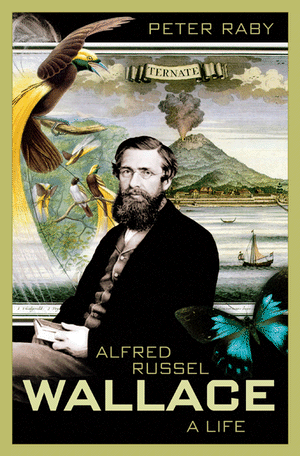
(Note 2: The image is the cover of Alfred Russel Wallace: A Life by Peter Raby.)

See also:

Sanity moment: Charles Darwin is not a saint

Aussie poli sci prof: Darwin's main claim to fame was his social status

Labels:

Saturday, July 05, 2008

Darwin's co-discoverer thought design can be detected in nature?

The evil Discovery Institute (intelligent design central) is offering a couple of podcasts of interest, one on Wallace, Darwin's co-discoverer of natural selection, in which they note ,
Many credit Alfred Russel Wallace, who along with Darwin co-presented the theory of natural selection in letters to the Linnean Society of London, 150 years ago this year. But few seem to remember that, contrary to Darwin, Wallace actually believed that it was possible to detect design in nature. So, what would modern Darwin defenders make of Wallace today?
That's probably why you don't hear much about him.

Also, John West offers some thoughts on Thomas Jefferson and intelligent design:

Critics of intelligent design sometimes claim they are defending the principles of American Founding Father Thomas Jefferson in trying to ban discussions of intelligent design. In the words of one writer, “Thomas Jefferson makes it quite clear that there was not a consensus of support among the authors of the Constitution... to support theological doctrines such as intelligent design.” But would Thomas Jefferson himself agree? In this special July 4th edition of ID the Future, Discovery Institute Senior Fellow John West explores the real views of Jefferson on intelligent design.

Labels: ,

Who links to me?